Have you ever stood in the electronics aisle, holding a smart light bulb, squinting at the fine print on the back of the box? You are trying to figure out if it works with Apple Home, your partner's Android phone, or the Alexa speaker sitting on your kitchen counter. If you have, you know the exact headache that kept millions of people from buying smart home gadgets for over a decade.
Building a connected home used to feel like picking a faction in a tech turf war. If you bought into one brand, you locked yourself into their hardware, their app, and their rules.
Thankfully, that era is finally closing. The smart home industry has rallied behind a single unifying standard called Matter, and it is reshaping how our living spaces work.
The Smart Home Fragmentation Crisis
For years, the smart home market suffered under the weight of walled gardens. Apple had HomeKit, Amazon had Alexa, and Google had its own Home ecosystem. If a device maker wanted to sell a smart plug, they had to write separate software code for each platform and pay for distinct certification badges.
Consumers bore the brunt of that mess. You ended up with a dozen different apps on your phone just to control the basic lights and switches in your house. Worse, your router ended up surrounded by an unsightly mess of plastic bridge hubs, each running its own closed wireless protocol like older Zigbee or Z-Wave systems. If your internet went down, half the automations in your house abruptly stopped firing.
The frustration triggered real fatigue. People simply stopped buying gear because they were terrified of picking the wrong brand. Recent data from the ASHB Smart Home Technology Trends Survey showed that as these compatibility barriers fell, adoption climbed from 49% in 2024 to 59% in 2025.¹ The market needed a universal fix, and the tech giants finally realized they had to cooperate.
What Exactly Is Matter and Why Should You Care?
Matter is an open-source, royalty-free connectivity standard managed by the Connectivity Standards Alliance (CSA).¹ Instead of fighting for exclusive control, Apple, Google, Amazon, and Samsung sat down at the same table to build a shared language for smart devices.
Think of Matter as the digital equivalent of USB or Bluetooth, but built specifically for connected home hardware. It does not replace your local network. Instead, it operates right on top of technologies you already use
• Wi-Fi: Used for high-bandwidth gadgets like smart appliances, TVs, and streaming devices that stay plugged into the wall.
• Thread: A low-power, self-healing wireless mesh network designed specifically for smaller battery-powered gadgets like door locks, motion sensors, and smart blinds.
• Ethernet: Wired connections for maximum reliability on fixed devices.
• Bluetooth Low Energy: Used strictly during the initial setup process to help your phone discover and configure the device in seconds.
Because Matter runs on standard internet protocol (IPv6), devices communicate with each other directly across your home. The old proprietary roadblocks disappear. You no longer have to check whether a smart plug supports your specific voice assistant. If it has the Matter logo, it works with all of them.
The standard also eliminated the early price gap. Although early compatible gear carried a noticeable price premium, budget brands like IKEA and TP-Link now sell reliable Matter smart plugs and bulbs for ten to fifteen dollars, bringing open interoperability to everyday buyers.
The End of Setup Struggles
Remember the old onboarding ritual? You had to download a manufacturer's app, create an account, verify an email, grant local network permissions, and pray that the device paired on the first try.
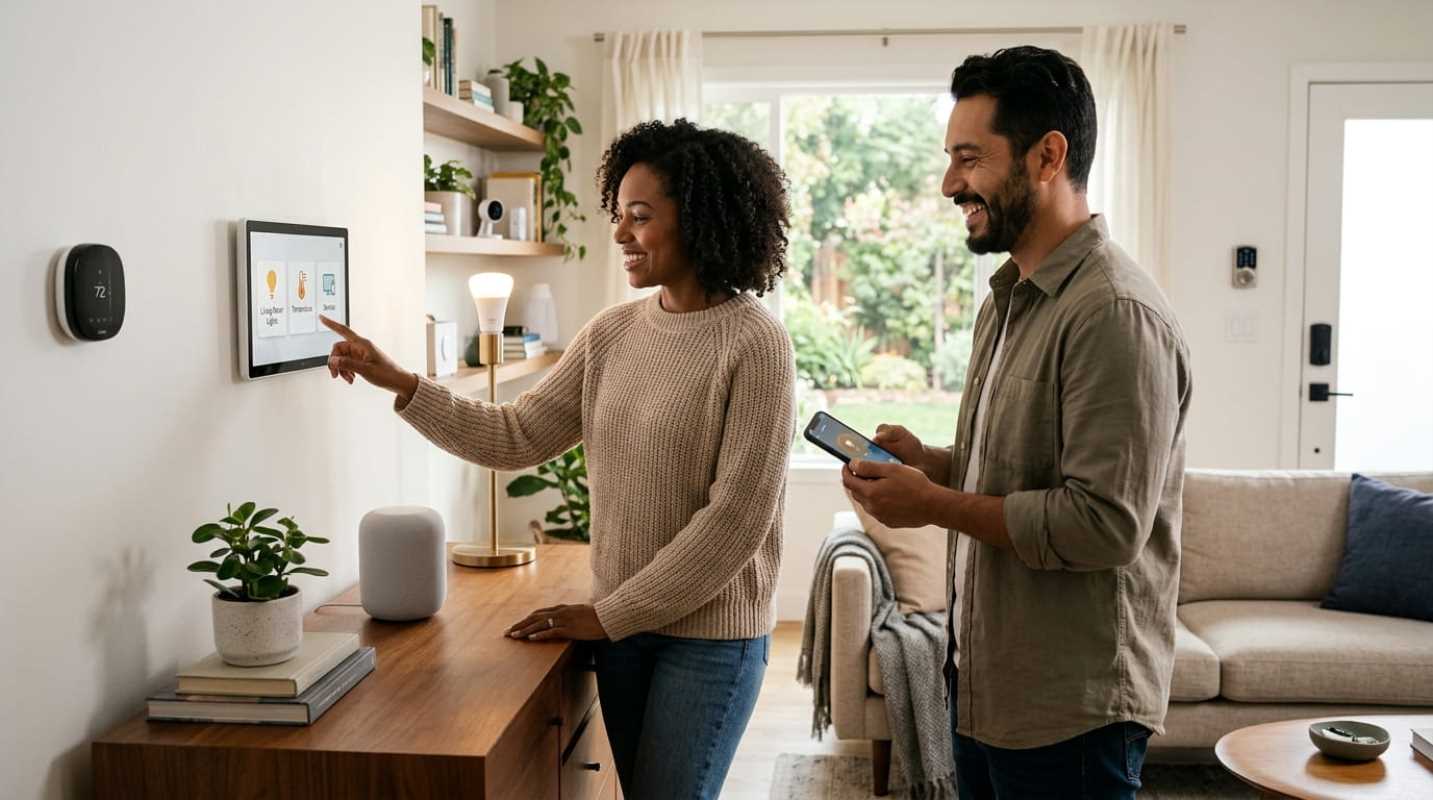
Matter tosses that entire sequence out the window through universal QR code commissioning. When you unbox a new gadget, you open whichever smart home app you actually like using. You scan the numerical code printed on the side of the device, and your platform configures it instantly. You never have to touch a sketchy third-party app again.
Even better, Matter solves the classic split-device household argument through a feature called Multi-Admin.
In many homes, one person carries an iPhone while someone else prefers a Google Pixel or a Samsung Galaxy. In the past, sharing device controls across different phone ecosystems required clumsy cloud workarounds. With Matter, a single smart device connects natively to multiple platforms at the exact same time. Your Apple Home app, your Google Home app, and your Amazon Echo can all control the exact same ceiling light without interfering with one another.
With the rollout of Matter 1.4's Improved Multi-Admin, that process became effortless.² Instead of generating complex manual pairing codes for every extra system, your apps can share device access behind the scenes with a single tap of your permission.
Future-Proofing Your Home Ecosystem
Buying smart gadgets used to feel like a gamble. If a small smart home startup went out of business or shut down its cloud servers, your expensive switches turned into useless wall decorations overnight.
Matter fixes this problem by prioritizing local control
• Sub-second response times: Commands move directly across your local network rather than bouncing to an overseas data center and back, dropping latency to under 100 milliseconds.
• Offline reliability: If your broadband provider suffers an outage, your schedules, wireless wall switches, and motion sensors keep running inside your home without missing a beat.
• Hardware independence: Because the device operates locally using open standards, it remains functional even if the original manufacturer stops supporting their original cloud portal.
• Built-in mesh networking: Devices like Apple TV 4K, HomePod, Nest Hub, and modern Echo speakers double as Thread Border Routers. They build a shared wireless mesh across your rooms automatically, eliminating separate hardware hubs.
Security gets a major upgrade as well. Every certified product carries a unique, cryptographically signed Device Attestation Certificate. When you pair a gadget, your system checks this certificate to confirm the hardware was legitimately tested and verified by the CSA. Rogue gadgets simply cannot slip onto your network.
A Seamless Future for Smart Living
We are witnessing smart home technology transform from an unreliable hobby into a dependable home utility. The shift feels very much like the transition home audio made years ago, moving from confusing rat's nests of proprietary speaker wire to simple, universal wireless playback.
As recent specification updates roll out, Matter's reach is expanding into energy management, heat pumps, home solar storage, and appliance controls. The days of balancing four different bridge hubs behind your television cabinet are behind us.
If you are buying new gear for your space today, do yourself a favor: look for the Matter badge on the packaging. It saves you setup headaches today, keeps your personal data contained inside your home network, and guarantees that your gear will still play nicely with whatever phone you decide to buy next.
Sources:
1. Matter Overview 2024
https://csa-iot.org/wp-content/uploads/2024/02/Matter-Overview_2024.pdf
2. Matter 1.4 Simplified Device Enrollment
https://matteralpha.com/explainer/matter-1-4-simplified-device-enrollment
3. ASHB Smart Home Technology Trends Survey
https://www.ashb.com/wp-content/uploads/2025/10/Survey-Executive-Summary-3.pdf